

Categories
Recent Blogs
Introduction
Choosing the right technology stack is one of the most important decisions when building a web application. It affects your project's performance, development speed, scalability, maintenance, and long-term success. Among the most popular backend technologies today are Laravel and Node.js.
Although they are often compared, Laravel and Node.js serve slightly different purposes. Laravel is a powerful PHP framework known for its elegant syntax and built-in features, while Node.js is a JavaScript runtime designed for building fast, scalable, and real-time applications.
So, which one should you choose? The answer depends on your project requirements, team expertise, and future business goals. In this blog, we'll compare Laravel and Node.js across multiple aspects to help you make an informed decision.
What is Laravel?
Laravel is an open-source PHP framework designed to simplify web application development. It follows the MVC (Model-View-Controller) architecture and provides developers with a clean, organized structure for building secure and scalable applications.
Laravel comes with numerous built-in tools, including authentication, routing, caching, database migrations, queues, validation, and an ORM called Eloquent, making development faster and more efficient.
Key Features of Laravel
Elegant MVC architecture
Built-in authentication and authorization
Eloquent ORM for database management
Blade templating engine
Artisan command-line tool
Database migrations and seeders
Strong security features
Large developer community
What is Node.js?
Node.js is an open-source JavaScript runtime built on Chrome's V8 engine. Instead of being a framework, it provides an environment where developers can execute JavaScript outside the browser.
Node.js uses a non-blocking, event-driven architecture, making it highly efficient for applications that require handling many simultaneous connections, such as chat apps, streaming services, and APIs.
Developers typically use frameworks like Express.js, NestJS, or Fastify with Node.js to build web applications.
Key Features of Node.js
Event-driven architecture
Non-blocking I/O operations
High performance
JavaScript for both frontend and backend
Excellent package ecosystem (npm)
Ideal for real-time applications
Highly scalable
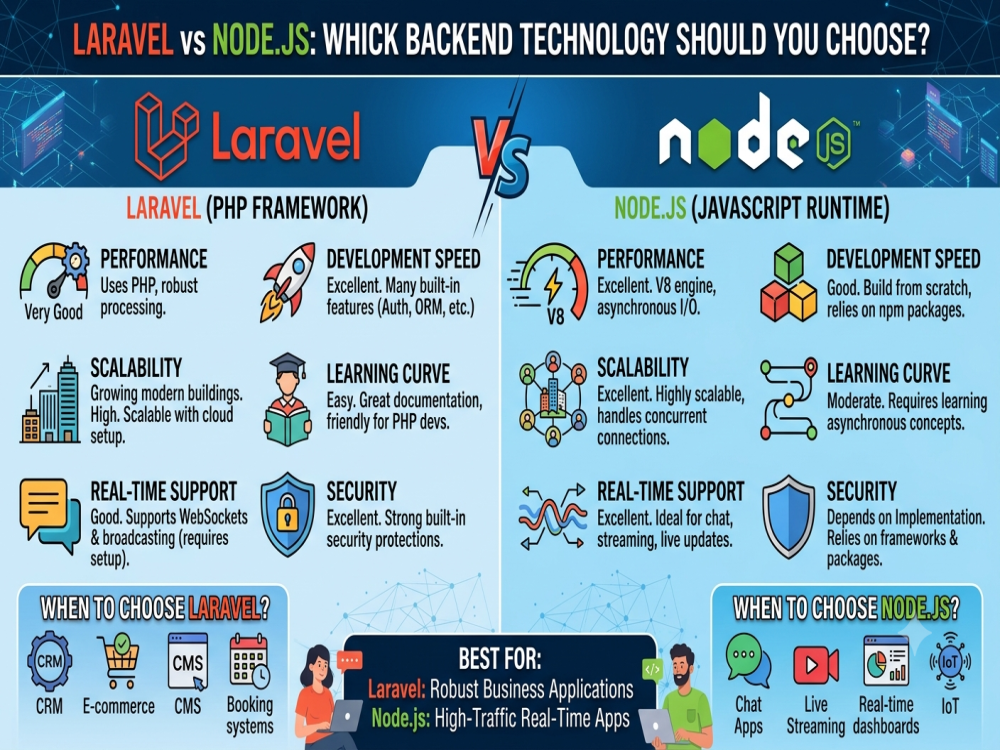
Laravel vs Node.js: Detailed Comparison
1. Performance
Node.js is generally faster because it uses Google's V8 JavaScript engine and processes requests asynchronously.
Laravel performs exceptionally well for traditional web applications but may not match Node.js in handling thousands of concurrent real-time connections.
Winner: Node.js
2. Development Speed
Laravel provides many built-in features that reduce development time.
Authentication, validation, routing, database management, email handling, queues, and security are available out of the box.
In Node.js, developers often need to integrate multiple packages manually.
Winner: Laravel
3. Learning Curve
Laravel is beginner-friendly, especially for developers familiar with PHP.
Node.js requires understanding asynchronous programming, callbacks, promises, and event-driven architecture, which can be more challenging for beginners.
Winner: Laravel
4. Scalability
Node.js is designed for highly scalable applications.
Its event-driven model efficiently handles thousands of simultaneous users, making it an excellent choice for applications expecting heavy traffic.
Laravel can also scale effectively using caching, queues, load balancers, and cloud infrastructure, but it often requires more configuration.
Winner: Node.js
5. Database Support
Laravel offers excellent database integration through Eloquent ORM.
It supports MySQL, PostgreSQL, SQLite, SQL Server, and more with elegant syntax.
Node.js supports virtually every database through various packages, giving developers greater flexibility.
Winner: Tie
6. Security
Laravel includes many built-in security features, including:
CSRF protection
SQL injection prevention
Password hashing
Authentication
Authorization
Encryption
Input validation
In Node.js, security largely depends on the frameworks and packages you choose.
Winner: Laravel
7. Real-Time Applications
Real-time applications like chat systems, gaming servers, live notifications, collaborative tools, and streaming platforms benefit greatly from Node.js.
Its event-driven architecture ensures smooth communication between clients and servers.
Laravel supports real-time functionality through tools like WebSockets and broadcasting but requires additional setup.
Winner: Node.js
8. Community and Ecosystem
Both Laravel and Node.js have large, active communities.
Laravel offers excellent documentation, packages, tutorials, and developer tools.
Node.js benefits from npm, the world's largest package ecosystem, providing libraries for almost every development need.
Winner: Tie
Laravel vs Node.js Comparison Table
When Should You Choose Laravel?
Laravel is the right choice if you are building:
Business websites
CRM systems
ERP software
E-commerce platforms
Blogs and CMS websites
Booking systems
Educational portals
Admin dashboards
Content management applications
Laravel is also ideal for teams looking for rapid development with strong built-in features and a structured framework.
When Should You Choose Node.js?
Node.js is a better option if you're developing:
Chat applications
Live streaming platforms
Real-time dashboards
Multiplayer games
Video conferencing applications
REST APIs
Microservices
IoT applications
High-traffic web platforms
Its asynchronous architecture makes it an excellent choice for applications that require fast data processing and real-time communication.
Can Laravel and Node.js Be Used Together?
Yes.
Many modern applications combine Laravel and Node.js to leverage the strengths of both technologies.
For example:
Use Laravel for authentication, user management, APIs, and database operations.
Use Node.js for chat systems, live notifications, WebSocket connections, and real-time updates.
Connect both services through REST APIs or message queues.
This hybrid approach allows businesses to build feature-rich, scalable, and high-performing applications.
Which One Should You Choose?
The best choice depends on your project requirements.
Choose Laravel if you want rapid development, built-in security, elegant database management, and a structured framework for traditional web applications.
Choose Node.js if your application requires high performance, real-time communication, scalability, and handling thousands of concurrent users efficiently.
For many businesses, the decision isn't about which technology is better overall—it's about selecting the one that best aligns with your project's goals and technical requirements.
Final Verdict
Laravel and Node.js are both outstanding technologies with their own strengths.
Laravel excels in rapid development, security, maintainability, and building feature-rich business applications. Its extensive built-in functionality allows developers to create robust web applications quickly with minimal configuration.
Node.js shines in performance, scalability, and real-time capabilities. It is the preferred choice for applications that demand speed, concurrent connections, and event-driven architecture.
Before making your decision, consider factors such as your project's complexity, expected traffic, development timeline, budget, and your team's expertise. By choosing the technology that best fits your business needs, you'll build a stronger, more scalable, and future-ready application.
MD SARFRAJ
Full stack developer
Comments 0
No comments yet.