

Categories
Recent Blogs
Ten years ago, businesses debated whether cloud computing would become mainstream.
Today, they ask the same question about Artificial Intelligence.
The difference is that AI is evolving much faster than previous technology revolutions.
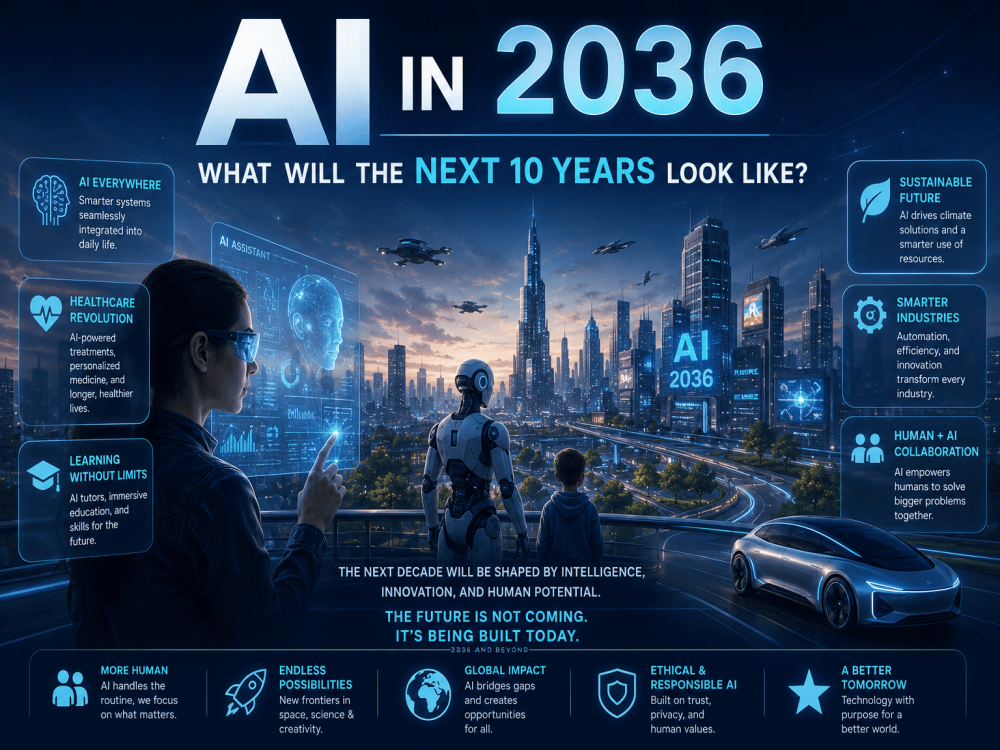
By 2036, AI will likely become an invisible layer embedded into almost every digital product, business process, and customer interaction.
AI Will Become Every Employee's Digital Partner
Today's AI acts as an assistant.
Tomorrow's AI will act as a teammate.
Instead of simply answering questions, AI agents will:
Schedule meetings
Write reports
Analyze business performance
Negotiate with software systems
Manage workflows
Coordinate with other AI agents
Industry research increasingly refers to this shift as the move toward "agentic AI."
Software Development Will Change Forever
Future developers will spend less time writing code.
Instead, they will focus on:
System architecture
Security
AI governance
Business logic
Product innovation
AI will generate much of the routine code while engineers validate, optimize, and guide complex solutions.
Every Business Will Become an AI Business
Healthcare.
Education.
Manufacturing.
Finance.
Retail.
Agriculture.
Government.
Every sector is expected to integrate AI into daily operations.
Businesses without AI capabilities may struggle to compete on speed, cost, and customer experience.
AI Will Create More Jobs Than It Eliminates
History shows that major technological revolutions often replace specific tasks while creating entirely new industries.
Emerging roles include:
AI Engineer
AI Product Manager
AI Auditor
AI Security Specialist
AI Compliance Officer
Prompt Engineer
AI Trainer
AI Operations Engineer
Rather than removing all jobs, AI is expected to reshape the skills employers demand.
The Rise of Autonomous Businesses
Imagine a company where AI can:
Generate marketing campaigns
Handle customer support
Analyze sales
Forecast demand
Detect fraud
Manage inventory
Produce financial summaries
Human teams will increasingly focus on strategy, creativity, governance, and relationship-building while AI manages routine execution.
Cybersecurity Will Become More Intelligent
As AI becomes more powerful, cyber threats will evolve too.
Future security systems will:
Detect attacks in real time
Predict vulnerabilities
Respond automatically
Continuously monitor infrastructure
AI will be essential for both attackers and defenders, making trust, governance, and security core priorities.
The Biggest Competitive Advantage
In 2036, competitive advantage won't come from simply using AI.
It will come from:
Better proprietary data
Strong AI governance
Secure infrastructure
Faster execution
Continuous innovation
Skilled people working effectively with AI
Technology alone won't be enough.
Execution will matter most.
What Should Businesses Do Today?
To prepare for the next decade, organizations should:
Start AI adoption now
Upskill employees continuously
Build secure AI governance
Invest in cloud and data infrastructure
Experiment with AI automation
Focus on business outcomes instead of hype
Companies that begin early will gain a meaningful advantage over competitors that delay adoption.
Final Thoughts
The next decade won't be defined by companies that simply use Artificial Intelligence.
It will be defined by companies that build with AI, manage AI responsibly, and innovate faster because of AI.
The future belongs to organizations that combine human creativity with intelligent automation—creating businesses that are smarter, faster, and more resilient than ever before.

Prashant Pandey
Product Manager
Comments 0
No comments yet.