

Categories
Recent Blogs
Introduction
Artificial Intelligence (AI) is no longer a futuristic concept reserved for large enterprises. In 2026, AI will become an essential tool for small and medium-sized businesses (SMBs) looking to improve efficiency, reduce costs, and stay competitive in an increasingly digital marketplace.
From automating repetitive tasks to delivering personalized customer experiences, AI is helping businesses work smarter rather than harder. Whether you own a retail store, an e-commerce business, a healthcare practice, a financial firm, or a service-based company, AI offers practical solutions that drive growth and innovation.
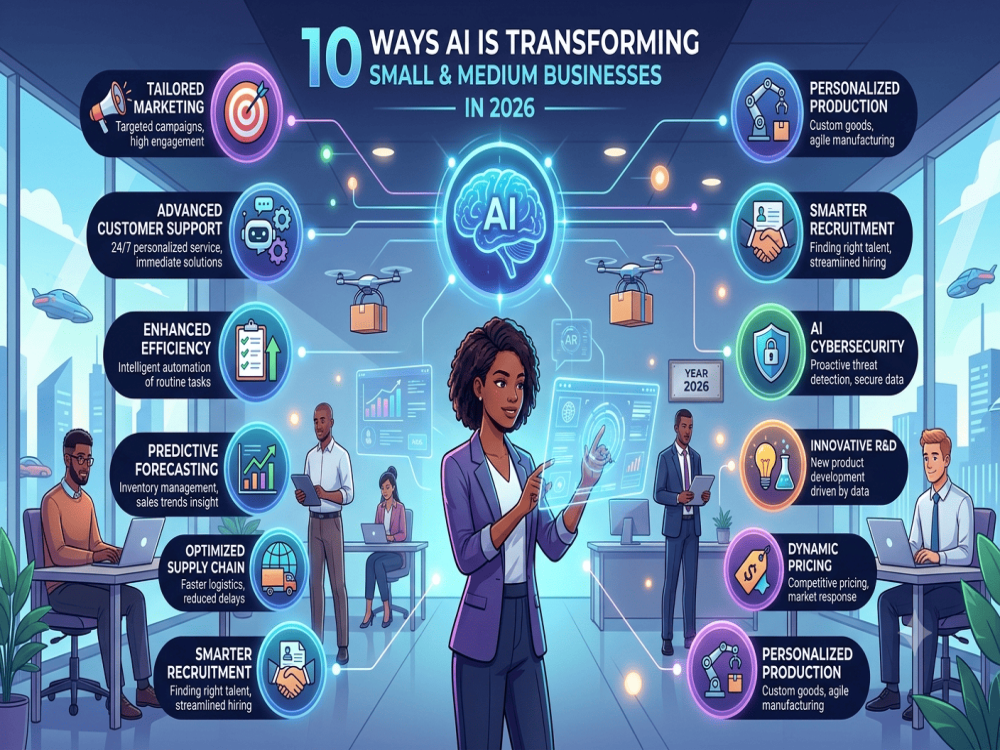
In this blog, we'll explore ten powerful ways AI is transforming small and medium businesses in 2026 and why adopting AI is becoming a necessity rather than a choice.
Why AI Matters for Small & Medium Businesses
Small businesses often operate with limited budgets, smaller teams, and tight deadlines. AI helps bridge these gaps by automating processes, analyzing data, and providing valuable insights that were once only available to large corporations.
By integrating AI into daily operations, businesses can improve productivity, enhance customer satisfaction, and make better strategic decisions.
1. Smarter Customer Support with AI Chatbots
AI-powered chatbots have become more intelligent and conversational than ever before.
They can:
Answer customer queries instantly
Handle multiple conversations simultaneously
Provide 24/7 customer support
Schedule appointments
Track orders
Collect customer feedback
This reduces response times while allowing support teams to focus on more complex customer issues.
2. Automated Business Operations
AI automates repetitive and time-consuming tasks, allowing employees to focus on high-value work.
Common automation tasks include:
Invoice generation
Appointment scheduling
Data entry
Email responses
Inventory updates
Workflow management
Automation not only saves time but also reduces human errors and operational costs.
3. Personalized Customer Experiences
Modern customers expect personalized interactions.
AI analyzes customer behavior, purchase history, browsing patterns, and preferences to deliver customized recommendations, targeted promotions, and personalized communication.
This leads to higher customer engagement, increased sales, and stronger brand loyalty.
4. Better Decision-Making Through Data Analytics
AI can process vast amounts of business data in seconds, identifying trends and patterns that might otherwise go unnoticed.
Business owners can use AI-powered analytics to:
Forecast sales
Identify customer behavior
Measure marketing performance
Monitor business growth
Improve financial planning
Data-driven decisions reduce uncertainty and improve business performance.
5. Improved Marketing Campaigns
AI is transforming digital marketing by making campaigns more efficient and targeted.
Businesses can use AI to:
Generate content ideas
Optimize advertisements
Predict customer interests
Personalize email marketing
Improve SEO strategies
Analyze campaign performance
This helps businesses achieve better marketing results while reducing advertising costs.
6. Enhanced Cybersecurity
As cyber threats continue to evolve, AI plays a critical role in protecting business systems.
AI-powered security solutions can:
Detect suspicious activities
Identify unusual login attempts
Prevent fraud
Monitor networks in real time
Respond to threats faster
Reduce security risks
For small businesses with limited IT resources, AI significantly strengthens cybersecurity.
7. Smarter Inventory and Supply Chain Management
Managing inventory efficiently is essential for profitability.
AI helps businesses:
Predict product demand
Monitor stock levels
Reduce overstocking
Prevent stock shortages
Optimize warehouse operations
Improve supplier management
This leads to lower operational costs and better customer satisfaction.
8. AI-Powered Financial Management
Financial management has become more efficient with AI.
Businesses can automate:
Expense tracking
Invoice processing
Financial forecasting
Budget planning
Cash flow analysis
Fraud detection
AI enables business owners to make faster and more informed financial decisions.
9. Increased Employee Productivity
AI acts as a digital assistant, helping employees complete tasks more efficiently.
Examples include:
Writing reports
Scheduling meetings
Summarizing documents
Managing projects
Organizing workflows
Automating repetitive office tasks
Employees spend less time on routine work and more time on innovation and customer engagement.
10. Better Sales Forecasting and Lead Generation
AI helps businesses identify high-quality leads and predict future sales opportunities.
Using machine learning, AI can:
Analyze customer behavior
Score potential leads
Predict purchasing patterns
Recommend follow-up actions
Improve conversion rates
This enables sales teams to focus on the prospects most likely to become customers.
Key Benefits of AI for Small & Medium Businesses
Businesses adopting AI in 2026 can enjoy numerous advantages, including:
Increased operational efficiency
Reduced business costs
Faster decision-making
Better customer experiences
Improved employee productivity
Stronger cybersecurity
More accurate forecasting
Higher sales conversions
Smarter marketing campaigns
Sustainable business growth
Common Challenges of AI Adoption
While AI offers tremendous benefits, businesses should also be aware of potential challenges:
Initial implementation costs
Employee training requirements
Data privacy concerns
Integration with existing systems
Choosing the right AI tools
Managing data quality
Planning carefully and adopting AI gradually can help overcome these challenges.
How to Start Using AI in Your Business
If you're new to AI, begin with areas that provide immediate value.
You can start by implementing:
AI chatbots for customer support
CRM software with AI capabilities
AI-powered email marketing tools
Business analytics platforms
Inventory management software
Accounting automation solutions
As your business grows, you can expand AI adoption across more departments.
The Future of AI in Business
AI technology continues to evolve rapidly, becoming more accessible and affordable for businesses of all sizes.
In the coming years, AI is expected to play an even greater role in customer service, automation, predictive analytics, cybersecurity, supply chain optimization, and personalized marketing.
Businesses that embrace AI today will be better prepared to compete, innovate, and adapt in an increasingly digital economy.
Final Thoughts
Artificial Intelligence is reshaping the way small and medium-sized businesses operate in 2026. By automating routine tasks, improving customer experiences, strengthening cybersecurity, and providing valuable business insights, AI empowers organizations to achieve more with fewer resources.
Rather than replacing human talent, AI enhances productivity and enables teams to focus on creativity, strategy, and meaningful customer relationships.
For SMBs looking to improve efficiency, reduce costs, and accelerate growth, investing in AI is no longer just an option—it's a strategic advantage. Businesses that adopt AI today will be better positioned to thrive in the competitive and technology-driven marketplace of tomorrow.
MD SARFRAJ
Full stack developer
Comments 0
No comments yet.